
Faculty Spotlight

Jonathan Banfill
Interview Transcript
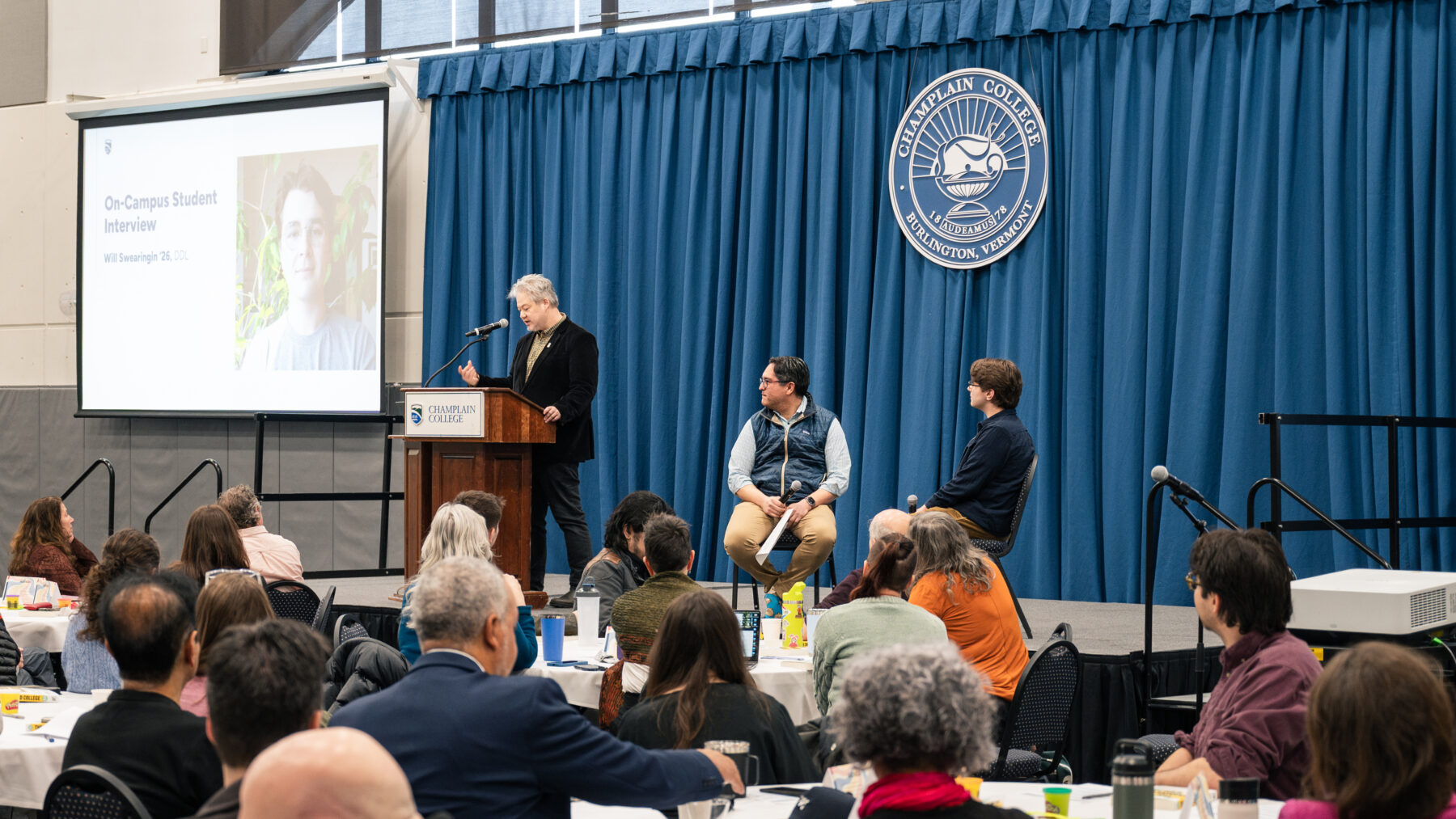
Interviewer: Parker Banas
In your opinion, what is the point of the competencies at Champlain?
I think the point of the competencies is to give a structure for learning that exists beyond any particular class. It’s a structure or system that holds skills running through the curriculum, allowing students to build self-agency and understand where all this material is going. A class isn’t just a singular thing—it’s part of this larger system that the school provides, but that students are also building with their own agency.
This changes how the outcome of learning is structured, shifting from “I’m just in this class learning content—I love the content, I hate the content, I love the teacher, I hate the teacher”—all those subjective reactions that people use to understand their learning experience. Thinking about the competencies allows for another level: “Okay, I’m in this class. Maybe I don’t like the teacher. Maybe the content is something I’ve never done before or am not interested in, but I can work on my analysis skills through the particularities of what’s happening in this individual class.”
So it’s a system for deepening learning and making it more active, which students should be excited about. Except students sometimes don’t appreciate the burden of agency that this requires. It’s supposed to build up over time.
How do you hope students will view the competencies?
I think they should view it as a system of areas that, if not comprehensive, are at least the things Champlain has chosen that create both consistency and a place of connection. They provide consistency because we’re all using the same language or conceptual areas—the big words of the competencies and all the ideas and rubrics underneath them. This gives a shared vocabulary.
If you’re talking across what would be called majors now, or areas of knowledge, it allows students across different years to talk and make connections—to see growth in ways that aren’t just about what you’re producing, which often gets judged very tightly to identity. In Capstone, for instance, people sometimes put students in competition: who can make the best product? The competencies stabilize that and say, “It’s actually about how you’re making things that hold these deeper-level metacognitive skills. How can I see that?”
Because these are meta-structural skills, everybody can bring different bits of content, and that’s important to unlock the specificity of each competency in a particular time in a class.
So I hope students understand that it’s a system that can be understood—one that helps give structure for what’s happening here. It provides structure beyond the quality of a particular course, a particular semester, or even your major. Learning is bigger than the way you’ve been arbitrarily organized within a set of faculty or program or whatever. Actually, the goal is something much bigger than what’s on your transcript or who your advisor is.
What lessons about the competencies do you want students to walk away from your class with?
Alex Hernandez has been using this idea of “super collisions”—the technical skills you’re gaining in your profession meeting with the concepts and big ideas you’re getting from other sets of classes, meeting with all the experiences you’re having in the world, both in formal and informal settings. Whether you’re volunteering, walking through Burlington on your own and seeing something, doing a Freeman program in another country, or organizing with the soccer team—the competencies provide connective points where you can thread and synthesize all these different things you’re doing together. They also help generate what those will look like in the future because they function as machines in that way.
What you’re trying to create here is this larger bundle of experiences that resonate with you as a person. The competencies help give a language or a map for understanding what that is and moving into the future.
What I’ve found working with them is interesting: when two competencies or three competencies start interacting and layering, they create a bigger structure that then works with the things you’re doing. This allows you to have language to talk about how two or three disparate experiences you’re having may come together to help you make yourself appear in the world. Champlain focuses on this in terms of workforce and getting jobs, but I think it also helps you appear as a human in the world.
What are some of the ways that you integrate the competencies in your class?
In Core 101, which is what I call a meta-educational class, we use competency cards as ways to talk about how these things connect to different experiences or how they connect to the classes students are having—their major classes. Where can you see these things? Where are you seeing these things? How do you imagine them working in the future? A lot of it is using them as a structure for talking about how to understand what you’re doing here and how it’s different from high school, for instance. Some students actually understand competencies because they had a version of it in high school, but we discuss what it looks like here.
The character sheet assignment asks: How can you use something from Dungeons and Dragons or other role-playing games to represent yourself—a version of yourself that’s here at Champlain, gathering experience and skills? It gives a model for tracking growth and experience in a playful way. I think it’s the same way that model works as the competencies might work. You have these things that are growing, that you’re gaining experience in.
If you give students the competency rubrics, they’re not going to read them. Or they don’t necessarily understand the specific language. So how do I as a teacher interpret some of those areas and weave them into the class without always saying “this is tied to this competency”? Sometimes I’ll say this class is tied this way, or in the reflective pieces, I’ll be asking specific questions that align with my understanding not just of the rubrics but how those are working within the world.
I think if you were to go as a student and take tests about competencies, that’s not the point. Doing a Freeman program, being in another country 24/7 for weeks, dealing with all this stuff—people who don’t communicate well because of language barriers—you can see all these competencies happening at once. Interesting things happen where communication and global cultural understanding intersect in some random office in Ho Chi Minh City.
How have students responded to these assignments and learning activities?
I just try to gently keep reminding: here’s a structure, there’s a system in place. That’s also a way to teach systems thinking, which is actually part of one of the sub-pieces and some of the key vocabulary words in the competencies.
I think as students advance and have more experiences and actively have their own self-agency, the more this language can be built. I think the hardest is when there’s a student who doesn’t have self-agency or we’re still trying to build it. You’re presenting the system, but they don’t have enough experience. So there’s a bit where experiences are happening and they need check-ins at various times to give that self-expression.
As teachers, we can see that our understanding of growth and time is much wider than a student’s in the first couple of years. The point is that you’re going through college, gaining experiences, and eventually finding times where there’s explicit check-in—times that are not tests. It’s much more organic assessment.
How have you used the competencies to get to where you are today, and which ones have been most important in your teaching?
That’s a good question because faculty are also learning what these are and how they intersect, what growth they have. As a system, they’ve been valuable for me to think about what I’m bringing into certain classrooms, what things I can teach.
As a teacher, it frees me from the need to know everything. It also frees me from the idea that teaching is making all students know the exact same thing. I don’t need them to—I’m going to be asking different questions and encountering different things in the world. I’ll have different modes of communication or creation than the students in my class.
But because I think about this stuff and practice it over and over again, I’m an example of how you might put all these things together to understand a practice. In some ways, I hope the competencies also allow students to interpret who their teacher is—someone balancing a variety of these things together and doing stuff in the world, as they should be as well. It’s not going to be the same.
This changes how the outcome of learning is structured, shifting from “I’m just in this class learning content—I love the content, I hate the content, I love the teacher, I hate the teacher”—all those subjective reactions that people use to understand their learning experience. Thinking about the competencies allows for another level: “Okay, I’m in this class. Maybe I don’t like the teacher. Maybe the content is something I’ve never done before or am not interested in, but I can work on my analysis skills through the particularities of what’s happening in this individual class.”
So it’s a system for deepening learning and making it more active, which students should be excited about. Except students sometimes don’t appreciate the burden of agency that this requires. It’s supposed to build up over time.